
Do Guitar Chords Work on Ukulele?
You already know your guitar chords. Then someone hands you a ukulele, you open a song you've played a hundred times, and the G chord you reach for comes out as a C.
Nothing is wrong with the ukulele, and nothing is wrong with you. You've just run into the one rule that connects the two instruments.
Short answer
Chord names don't change between guitar and ukulele. A song in G is in G on both, so a guitar chord chart works on a ukulele as written — you just play the ukulele shape for each chord. What does change is the fingering: a ukulele is tuned like a guitar's top four strings with a capo on fret 5, so a guitar shape played on a uke sounds five semitones higher. Your G shape makes a C. Your D shape makes a G.
That one number — five — is the whole conversion. Everything else in this guide is that rule applied: a full chart of what each guitar shape becomes, three ways to handle a whole song, and the handful of chords that don't survive the move to four strings.
Why a Ukulele Is a Guitar With a Capo on Fret 5
A guitar in standard tuning is E A D G B E, low string to high. Cover up the two lowest strings and you're left with D G B E.
A ukulele is tuned G C E A. Line the two up and every ukulele string sits exactly five semitones — a perfect fourth — above the matching guitar string. D to G, G to C, B to E, E to A.
Five semitones is five frets. So if you clamp a capo on the 5th fret of a guitar, its top four strings play G, C, E and A: ukulele tuning. Pick a tuning below to see which guitar note each ukulele string really is.
Soprano, concert and most tenor ukuleles
- GD string, 5th fretUkulele string pitch: G4Octave up
- CG string, 5th fretUkulele string pitch: C4 (middle C)Same pitch
- EB string, 5th fretUkulele string pitch: E4Same pitch
- AHigh E string, 5th fretUkulele string pitch: A4Same pitch
The one asterisk is the G string. On most soprano, concert and tenor ukuleles it's tuned an octave higher than you'd expect, so the lowest note on the instrument is the C, not the G. That's called re-entrant tuning, and it's why a ukulele sounds bright and sparkly instead of like a small guitar.
For chord shapes, that octave makes no difference. A C chord is a C chord whichever octave its G lands in.
Same fingers, new name: a guitar shape on a ukulele is always five semitones higher.
If capos are new to you, the guitar capo chart covers the same idea from the guitar side: every fret you move up is one semitone higher.
Guitar to Ukulele Chord Chart
Every shape below has been checked note by note. Its top four strings on a guitar are exactly the standard ukulele fingering for the chord five semitones up. Pick a shape to see both boxes side by side. The purple strings are the ones the two instruments share.
Pick a guitar shape you already know
C
C Major
0 0 0 3
Drop the two bass strings from a guitar G and you are left with 0 0 0 3 — the ukulele C. On a baritone ukulele the same grip is still G.
And here is the whole map in one place:
- Guitar CF on uke2 0 1 0Baritone: C
- Guitar AD on uke2 2 2 0Baritone: A
- Guitar GC on uke0 0 0 3Baritone: G
- Guitar EA on uke2 1 0 0Baritone: E
- Guitar DG on uke0 2 3 2Baritone: D
- Guitar AmDm on uke2 2 1 0Baritone: Am
- Guitar EmAm on uke2 0 0 0Baritone: Em
- Guitar DmGm on uke0 2 3 1Baritone: Dm
- Guitar G7C7 on uke0 0 0 1Baritone: G7
- Guitar E7A7 on uke0 1 0 0Baritone: E7
- Guitar D7G7 on uke0 2 1 2Baritone: D7
- Guitar B7E7 on uke1 2 0 2Baritone: B7
- Guitar Dm7Gm7 on uke0 2 1 1Baritone: Dm7
- Guitar Gmaj7Cmaj7 on uke0 0 0 2Baritone: Gmaj7
- Guitar Dmaj7Gmaj7 on uke0 2 2 2Baritone: Dmaj7
- Guitar Emaj7Amaj7 on uke1 1 0 0Baritone: Emaj7
- Guitar Dsus2Gsus2 on uke0 2 3 0Baritone: Dsus2
- Guitar Dsus4Gsus4 on uke0 2 3 3Baritone: Dsus4
- Guitar Asus2Dsus2 on uke2 2 0 0Baritone: Asus2
- Guitar Esus4Asus4 on uke2 2 0 0Baritone: Esus4
- Guitar FBb on uke3 2 1 1Baritone: F
- Guitar FmBbm on uke3 1 1 1Baritone: Fm
- Guitar BbEb on uke3 3 3 1Baritone: Bb
- Guitar BE on uke4 4 4 2Baritone: B
| Guitar shape | Top four stringsD G B E | Standard ukuleleG C E A — sounds as | Baritone ukuleleD G B E — sounds as |
|---|---|---|---|
| C | 2 0 1 0 | F | C |
| A | 2 2 2 0 | D | A |
| G | 0 0 0 3 | C | G |
| E | 2 1 0 0 | A | E |
| D | 0 2 3 2 | G | D |
| Am | 2 2 1 0 | Dm | Am |
| Em | 2 0 0 0 | Am | Em |
| Dm | 0 2 3 1 | Gm | Dm |
| G7 | 0 0 0 1 | C7 | G7 |
| E7 | 0 1 0 0 | A7 | E7 |
| D7 | 0 2 1 2 | G7 | D7 |
| B7 | 1 2 0 2 | E7 | B7 |
| Dm7 | 0 2 1 1 | Gm7 | Dm7 |
| Gmaj7 | 0 0 0 2 | Cmaj7 | Gmaj7 |
| Dmaj7 | 0 2 2 2 | Gmaj7 | Dmaj7 |
| Emaj7 | 1 1 0 0 | Amaj7 | Emaj7 |
| Dsus2 | 0 2 3 0 | Gsus2 | Dsus2 |
| Dsus4 | 0 2 3 3 | Gsus4 | Dsus4 |
| Asus2 | 2 2 0 0 | Dsus2 | Asus2 |
| Esus4 | 2 2 0 0 | Asus4 | Esus4 |
| F | 3 2 1 1 | Bb | F |
| Fm | 3 1 1 1 | Bbm | Fm |
| Bb | 3 3 3 1 | Eb | Bb |
| B | 4 4 4 2 | E | B |
Frets are read low string to high. On a ukulele that order is G C E A.
A few patterns are worth noticing:
- The guitar's G family becomes the ukulele's C family. G, D, Em and C on guitar are C, G, Am and F on uke — the four chords a huge share of ukulele songs are built on.
- The guitar's E shape is the ukulele A, and E7 is A7. Both are easy, open grips on either instrument.
- The guitar F barre is the ukulele B♭. The chord that makes guitar beginners quit becomes the chord that makes ukulele beginners quit. Difficulty travels with the shape.
How to Convert a Guitar Chord Chart to Ukulele
If you have a guitar chord sheet and want to play the song on a ukulele, here is the whole method:
- 1
Leave the chord names alone
A chord chart describes sound, not fingers. A G on a guitar chart is a G on a ukulele, so the key of the song does not change and nothing needs transposing.
- 2
Swap each guitar fingering for the ukulele one
Look up the ukulele shape for every chord in the song. Most songs use four to six chords, and the common ones — C, G, Am, F, D and Em — are among the first shapes every ukulele player learns.
- 3
Simplify what four strings cannot hold
Play slash chords without their bass note, so G/B becomes G. If a 9th, 11th or 13th chord is a stretch, play the 7th chord underneath it instead.
- 4
Move awkward keys somewhere friendlier
If the song sits in a key that is hard on a ukulele — B and E are the usual offenders — transpose every chord by the same number of semitones into an easier key such as C, G or F.
- 5
Check the key against your voice
The key is the same as on guitar, so if the original suited your voice it still will. If not, shift the whole chart up or down until the chorus sits comfortably.
Notice what isn't on that list: transposing the song. A chord chart describes what the music sounds like, not where your fingers go, so the names carry straight across. Transposing only comes in when you want a different key, not because you changed instrument.
Convert a Whole Song: Three Ways
There are three ways to get a guitar chart onto a ukulele, and they don't give the same result. Paste a chart below and switch between them:
Nothing to transpose. Keep every chord name and play these ukulele shapes. The song sounds in the same key as the guitar version.
G
G Major
GCEA○○○○1120 2 3 2
D
D Major
GCEA○○○○1112 2 2 0
Em
E Minor
GCEA○○○○1230 4 3 2
C
C Major
GCEA○○○○10 0 0 3
Am
A Minor
GCEA○○○○12 0 0 0
D7
D Dominant 7th
GCEA○○○○11122 2 2 3
- Same names, ukulele shapes. The right answer almost every time. You stay in the original key, you match the recording, and anyone playing from the same chart is with you.
- Same key, guitar shapes. Rename every chord five semitones down and finger the guitar shape for the new name. A G becomes a D shape, a C becomes a G shape. It gets you playing tonight, but the chart in front of you no longer matches anyone else's.
- Guitar shapes as written. Everything sounds a perfect fourth higher. A song in G comes out in C. Fine on your own if your voice likes it up there. Wrong as soon as someone plays along.
Quick tip
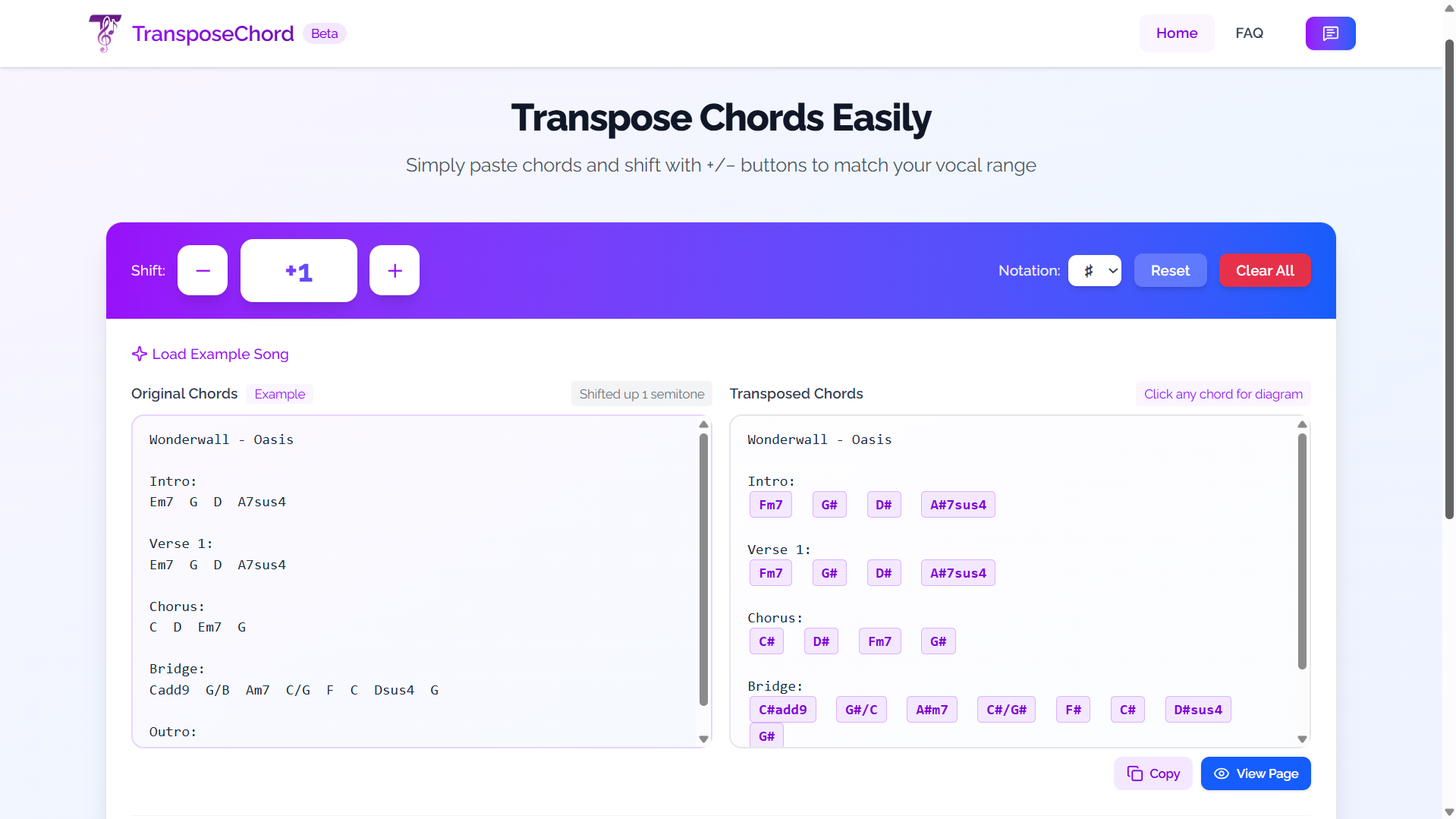
Want a song in a friendlier ukulele key as well? Paste it into the ukulele transposer — it shifts every chord and draws the uke shape for each one:
Open the ukulele transposer →Guitar Chords That Don't Convert Cleanly
Four strings can't do everything six can. These are the places the conversion breaks, and what to play instead:
- Shapes with their root on the bass strings. Cmaj7, Am7, Amaj7, A7 and Cadd9 all keep their root note on the A or low E string. Take those strings away and the chord changes identity: the top four strings of a guitar Cmaj7 are just an E minor chord, and Am7's are a plain C. On a ukulele those grips play Am and F — not the Fmaj7 and Dm7 the five-semitone rule promises. Learn the real ukulele shapes for these.
- Slash chords. G/B or D/F♯ means a chord over a particular bass note. A ukulele has no bass string to play it on, so play the chord before the slash: G/B becomes G.
- Power chords and bass riffs. E5, A5 and anything built on the low strings has nowhere to go. Play the full major or minor chord instead.
- Big extended chords. A 13th chord has up to seven notes, and a ukulele has four strings. Ukulele charts quietly drop the less important notes or play the 7th chord underneath. Our transposer does the same.
And even when a shape converts perfectly, the sound won't. A ukulele has no low end, so a song that leans on a big open-guitar strum will feel lighter. That's not a mistake. It's the instrument.
Going the Other Way: Ukulele Chords on Guitar
The rule runs in reverse too. Chord names still don't change, so a ukulele songbook works on guitar as written once you learn the guitar shapes.
If you're a ukulele player picking up a guitar, though, your shapes are a head start. Play them on the guitar's top four strings and they sound five semitones lower:
- Ukulele C shape (one finger on the 3rd fret of the A string) → guitar G
- Ukulele F shape → guitar C
- Ukulele G shape → guitar D
- Ukulele Am shape → guitar Em
Strum only the top four strings at first. Once those feel natural, add the bass strings by learning the full six-string versions. The easiest guitar keys for beginners are a good place to start, since G and C will feel familiar already.
Baritone Ukulele: No Conversion Needed
A baritone ukulele is tuned D G B E: the same four notes, in the same octave, as the top four strings of a guitar. For a guitarist, that makes it the easiest ukulele there is.
Every shape in the chart above is a baritone shape for the same chord name. A guitar G grip on a baritone is a G. No five-semitone rule, no renaming, nothing to convert.
The catch shows up in the other direction. Most ukulele songbooks draw their chord boxes for G C E A tuning. Play those standard diagrams on a baritone and everything sounds five semitones lower. The soprano-to-baritone converter draws both grips for any chord.
Guitar to Ukulele Questions, Answered
Can you play guitar chords on a ukulele?
Yes. Chord names mean the same thing on both instruments, so a guitar chord chart can be read on a ukulele as written — a G is a G. You play the ukulele shape for each chord instead of the guitar shape. If you play guitar fingerings on a ukulele unchanged, every chord comes out five semitones higher.
Why does a guitar G shape make a C chord on ukulele?
A ukulele’s G C E A strings are tuned five semitones — a perfect fourth — above a guitar’s top four strings, D G B E. Every shape moves up by that same amount, so a G shape sounds as C, a D shape as G, an E shape as A, and an Am shape as Dm.
Is a ukulele the same as a guitar with a capo on the 5th fret?
Almost. With a capo on fret 5, a guitar’s top four strings play G, C, E and A — ukulele tuning — and the C, E and A strings match a ukulele’s pitch exactly. On most ukuleles the G string is tuned an octave higher (re-entrant tuning), which is part of why a ukulele sounds so bright. A low-G ukulele matches the capoed guitar note for note.
Do I need to transpose guitar chords for ukulele?
No. The song stays in the same key on both instruments, so you only change the shapes. Transposing is for two other situations: you want to keep using guitar fingerings (rename every chord five semitones down), or the key is awkward on ukulele or wrong for your voice.
Which guitar chords don’t convert to ukulele?
Anything that depends on the two lowest strings. Slash chords lose their bass note, so play G/B as G. Shapes that keep their root on the bass strings — Cmaj7, Am7, Amaj7, A7 and Cadd9 — turn into different chords on the top four strings, so learn their ukulele shapes separately. Power chords played on the low strings have no direct ukulele equivalent.
How do I convert ukulele chords to guitar?
Chord names stay the same, so learn the guitar shape for each one. If you play your ukulele shapes on a guitar’s top four strings, they sound five semitones lower: the ukulele C shape gives a guitar G, the F shape gives C, and the G shape gives D.
Can I play guitar chords on a baritone ukulele?
Yes, directly. A baritone ukulele is tuned D G B E, the same notes as a guitar’s top four strings, so a guitar shape played on those four strings is the same chord on a baritone. A guitar G shape is a G. No conversion is needed.
Free tool
Paste the song. Get the uke shapes.
Transpose any chord chart into a ukulele-friendly key and see the fingering for every chord — standard or baritone.
Ukulele chord transposer →Back on guitar? Use the guitar transposer