Why the Chords Sound Wrong
You found the chords. E, A, B7 — easy. You put the record on, start strumming along, and it sounds awful. Not slightly off. Every chord clashes with every chord.
Your guitar is fine. The chord sheet is fine. The problem is one line at the top of the sheet that most people skip: Tuning: E♭ A♭ D♭ G♭ B♭ E♭.
The guitarist on that recording tuned every string down a half step. Their fingers made an E shape, but the note that came out was E♭. You're playing the right shape on a guitar that's one semitone higher than theirs.
Same shapes, different guitar. That half step is the whole problem — and it's also the whole fix.
What Half Step Down Tuning Is
Half step down tuning — also called E♭ tuning, E flat tuning, E♭ standard or semitone down tuning — lowers all six strings by one semitone. Low to high, the strings become E♭ A♭ D♭ G♭ B♭ E♭ instead of E A D G B E.
Because every string moves by the same amount, nothing about how you play changes. Every chord shape, scale pattern and riff is exactly where it was. The only thing that changes is the pitch: everything you play sounds one semitone lower than its name.
Guitarists do it for a few reasons:
- Looser strings. A half step less tension makes bends and vibrato noticeably easier — a big part of why blues and rock players adopted it.
- A darker, heavier tone. The same chords ring a little lower and thicker.
- The singer. Dropping the whole band a semitone can be the difference between hitting the chorus and straining for it.
Jimi Hendrix, Stevie Ray Vaughan, Eddie Van Halen and Guns N' Roses all tuned down a half step, which is why so many of the most-searched rock and blues songs come with that tuning note on their chord sheets.
Tuning Chart: Half Step Down and Beyond
Half step down is the most common alternate tuning, but the same logic covers every "standard tuning, only lower" variant. The number that matters is the last column: how far each chord sounds below its name.
| Tuning | Strings (low → high) | Compared with standard |
|---|---|---|
| StandardE standardChord names unchanged | E A D G B E | Chord names unchanged |
| Half step downE♭ standard, E♭ tuningChords sound 1 semitone lower | E♭ A♭ D♭ G♭ B♭ E♭ | Chords sound 1 semitone lower |
| Whole step downD standardChords sound 2 semitones lower | D G C F A D | Chords sound 2 semitones lower |
| C♯ standardD♭ standard, 1½ steps downChords sound 3 semitones lower | C♯ F♯ B E G♯ C♯ | Chords sound 3 semitones lower |
| C standardtwo whole steps downChords sound 4 semitones lower | C F B♭ E♭ G C | Chords sound 4 semitones lower |
| Drop Dlow E dropped to DChord names unchanged | D A D G B E | Chord names unchanged |
| Drop C♯Drop D♭, half step down + dropChords sound 1 semitone lower | D♭ A♭ D♭ G♭ B♭ E♭ | Chords sound 1 semitone lower |
| Drop Cwhole step down + dropChords sound 2 semitones lower | C G C F A D | Chords sound 2 semitones lower |
Notice the drop tunings. Drop D only retunes the low string, so its chord names don't move at all. Drop C♯ is half step down with the low string dropped a further whole step, so for chord purposes it behaves exactly like E♭ tuning.
How to Tune Your Guitar Half a Step Down
Tuning a guitar half a step down takes a couple of minutes with any chromatic tuner: clip-on, pedal or a free phone app. Put it in chromatic mode, not "guitar" mode. Guitar mode only knows E A D G B E and will keep steering you back to standard.
- 1Lower the 6th string (low E) to E♭. Your tuner may show it as D♯, which is the same note.
- 2Lower the 5th string (A) to A♭. Your tuner may show it as G♯, which is the same note.
- 3Lower the 4th string (D) to D♭. Your tuner may show it as C♯, which is the same note.
- 4Lower the 3rd string (G) to G♭. Your tuner may show it as F♯, which is the same note.
- 5Lower the 2nd string (B) to B♭. Your tuner may show it as A♯, which is the same note.
- 6Lower the 1st string (high E) to E♭. Your tuner may show it as D♯, which is the same note.
Two habits keep it in tune:
- Go a little below each note, then tune up to it. Coming up to pitch takes the slack out of the string and the tuning peg, so it holds instead of creeping flat.
- Go round all six strings a second time. Loosening one string lets the neck relax slightly, which pulls the strings you already tuned a little sharp.
No chromatic tuner? Match the low string to an E♭ from a piano or the recording, then tune the rest by ear with the usual fifth-fret method. The gaps between strings are the same as in standard tuning, so the method works unchanged. Many pedal tuners also have a flat-tuning setting (often shown as ♭1) that reads out the normal string names while you tune a semitone lower.
Is Your Chord Sheet Showing Shapes or Real Chords?
Before converting anything, work out which kind of sheet you have. Chord sites write tuned-down songs both ways, and the fix is opposite for each.
- Shapes: the sheet mentions half step down or E♭ tuning, and the chords are friendly letters like E, A, D, G and B7. These are the shapes the guitarist held, not the pitch you hear. This is the common case, and the converter below is for it.
- Real chords: the sheet lists E♭, A♭, B♭ and Cm with no tuning note. These are already the pitch of the recording, written for standard tuning. They will sound right as written; they are just awkward to play.
Quick test: if a song by a famously tuned-down band is written entirely in open-chord letters, you're looking at shapes.
Convert a Tuned-Down Song to Standard Tuning
Pick the tuning your sheet was written for and type its chords. You'll get what the recording actually plays, and every capo position from 0 to 7 that reproduces it on a guitar in standard tuning — with the barre chords greyed out so you can pick the friendliest row.
What the recording actually plays
Eb Ab Bb7
Easiest way in standard tuning
Capo on fret 1, then play D G A7. No barre chords.
- No capoEbAbBb73 barre
- Capo 1DGA7all open
- Capo 2DbGbAb73 barre
- Capo 3CFG71 barre
- Capo 4BEGb72 barre
- Capo 5BbEbF73 barre
- Capo 6ADE7all open
- Capo 7AbDbEb73 barre
Grey chords are barre shapes. Every row sounds identical to the recording.
Take the default example, a blues in E written for half step down. The record plays E♭, A♭ and B♭7 — three barre chords in standard tuning. Put a capo on fret 1, though, and the same sound comes out of D, G and A7: three of the first chords anyone learns.
Three Ways to Play It in Standard Tuning
1. Move every chord down a half step
The direct translation. E becomes E♭, A becomes A♭, B7 becomes B♭7, and the song matches the recording exactly. It's also the only option that works for everyone — piano, bass, a second guitarist — because it changes the song, not your instrument.
The catch: it usually lands you in flat keys full of barre chords. For a strummed song that may be fine; for anything with open-string riffs, it isn't.
Whole song at once
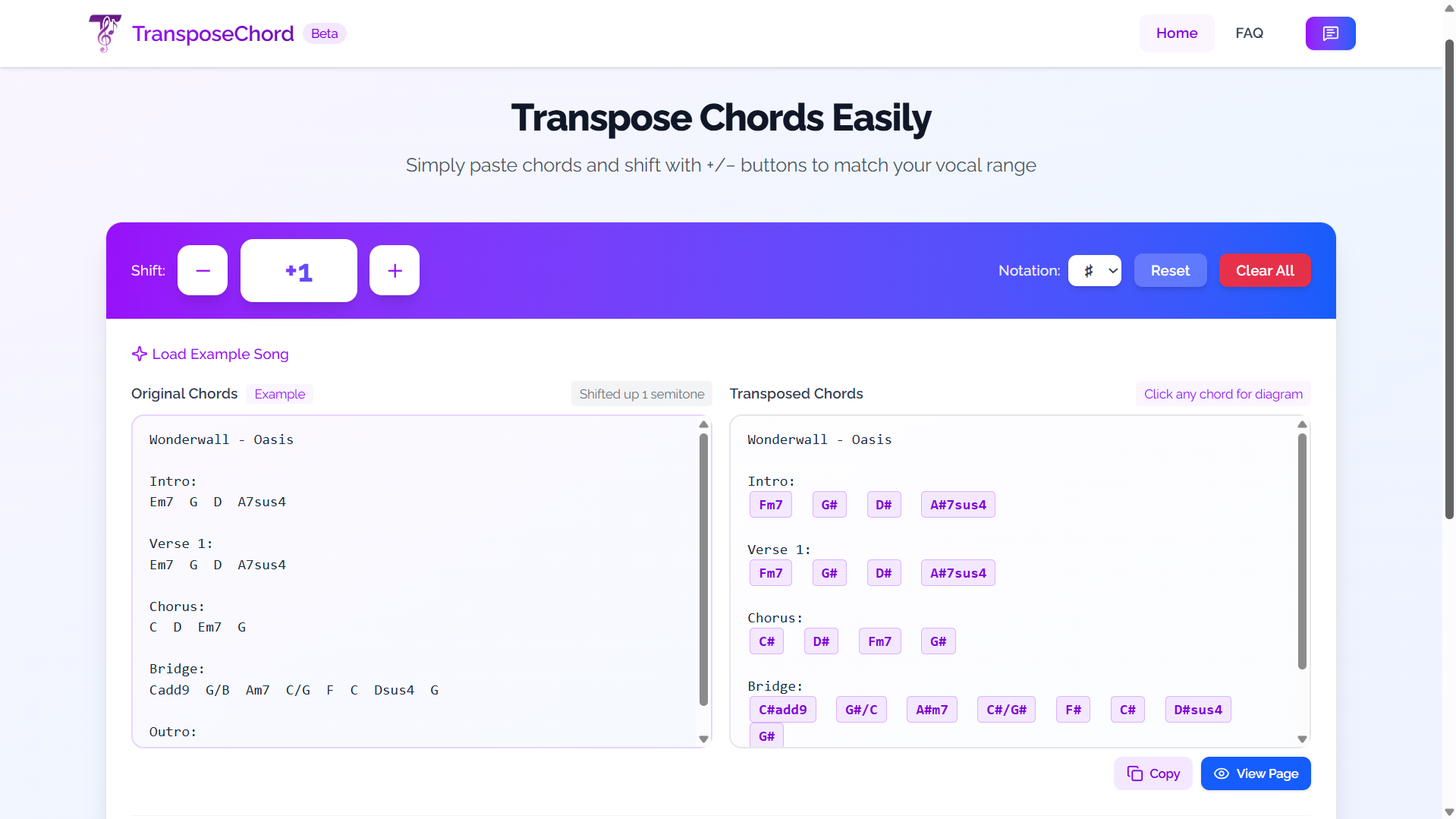
Got the full chord-over-lyrics sheet? Paste all of it, press − once for half step down, and every chord moves with the lyrics still lined up:
Use TransposeChord →2. Capo 1 and move every chord down two
This is the trick most guides skip. A capo can't go below standard, but it can overshoot and come back: capo on fret 1 raises the guitar a semitone, so you move the shapes down two to land exactly one below where you started.
For songs in the E and A shape family — which is most half-step-down rock and blues — that turns E, A and B into D, G and A. Open chords, identical sound. If capo 1 doesn't give you open shapes for your song, the converter shows every other position — a G-shape song in E♭ tuning comes out as D, G and A at capo 4, and an E-shape song as A, D and E at capo 6. Our guitar capo chart explains why any key is reachable from an open-chord family within a few frets.
3. Actually tune down
If the song is riff-driven — single-note lines on the low E string, open-string drones, solos you're learning note for note — tune down. Chord conversion moves chords; it can't move a riff that depends on the open low E♭ ringing. A few minutes with a tuner (see how to tune half a step down above) gets you the real thing, and every tab for the song works as written.
And if you're playing alone with nobody to match? Play the shapes as written in standard tuning. The song comes out a half step higher than the record, and unless you're singing along to the original key, nobody can tell.
Going the Other Way: Standard Songs on a Tuned-Down Guitar
Some players leave a guitar permanently in E♭. To play a standard-tuning song on it, there are two answers:
- Capo 1. A capo on the first fret of a half-step-down guitar puts it at exactly standard pitch. Play the sheet as written. (Capo 2 does the same for D standard.)
- Move every chord up a half step. E♭ shapes become E, A♭ becomes A. Useful when the song sits in a flat key: a song in E♭ is the open key of E on a tuned-down guitar.
That second point is why worship teams and singer-songwriters sometimes tune down on purpose: it turns E♭, A♭ and B♭ — keys that singers and horn players love and guitarists hate — into E, A and B. If you're choosing a key for your own voice, our guide to changing the key of any song for your voice covers that side, and basic guitar keys for beginners ranks every key by how many barre chords it costs.
Tuning Questions, Answered
What is half step down tuning?
Half step down tuning lowers all six guitar strings by one semitone, from E A D G B E to E♭ A♭ D♭ G♭ B♭ E♭. The chord shapes don’t change at all — but every chord sounds a half step lower than its name, so an E shape plays an E♭ chord.
Is E♭ tuning the same as half step down?
Yes. Half step down, E♭ tuning, E♭ standard and “E flat tuning” all describe the same thing: standard tuning with every string lowered one semitone.
How do I tune my guitar half a step down?
Set a tuner to chromatic mode and lower each string one semitone: low E to E♭, A to A♭, D to D♭, G to G♭, B to B♭ and high E to E♭. Most tuners show these as D♯, G♯, C♯, F♯, A♯ and D♯. Then check every string a second time, because loosening one string lets the others drift slightly sharp.
How do I play half step down songs in standard tuning?
Move every chord on the sheet down one semitone: E becomes E♭, A becomes A♭, B becomes B♭. That matches the recording exactly. If that means too many barre chords, put a capo on fret 1 and move every chord down two semitones instead — E becomes D, A becomes G, B becomes A — which sounds identical.
Can I just play the chords as written in standard tuning?
Yes, if you are playing alone. The song will sound a half step higher than the record, which nobody notices on its own. It only matters when you play along with the recording, play with a band reading the original, or the singer needs the original key.
Can a capo put a tuned-down guitar back to standard?
Yes. A capo on fret 1 of a guitar tuned half step down gives exactly standard pitch, and a capo on fret 2 does the same for whole step down (D standard). The capo can only raise pitch, so it can never take a standard-tuned guitar down to E♭.
Why do guitarists tune down a half step?
Looser strings are easier to bend and vibrato, the tone gets slightly darker and heavier, and it drops the whole song a semitone, which helps singers reach the top notes. Jimi Hendrix, Stevie Ray Vaughan, Eddie Van Halen and Guns N’ Roses all made it a rock and blues habit.
Does Drop D change the chord names?
No. Drop D only lowers the low E string to D; the other five strings stay in standard, so chord names on a Drop D sheet already match what you hear. Drop C♯ is different — it is half step down tuning with the low string dropped, so its chords sound a semitone lower than written.
Free tool
Don't retune. Transpose.
Paste a tuned-down chord sheet, shift it to standard pitch, and see the fingering for every chord you land on.
transposechord.com →